Monday, December 20, 2010

Wind Turbine Foundation and Tower System Design Course Available Feb. 22-23rd


For those interested in training opportunities for Wind Turbine Foundation and Tower Design a course will be held February 22-23rd in Santa Clara, California.  Attendees will:

-Develop design know-how in this rapidly developing area
-Gain in-depth understanding of the mechanics and principles of structural tower loads on foundations
-Become a valuable, contributing member of your company’s design team
-Gain working knowledge of the design of shallow through deep foundation systems for wind turbines including ground improvement

Instructors include skilled professionals from Vestas Technology, Con Tech Systems, Ltd., Renewable Energy Systems Americas, Inc., Earth Systems Global, Inc, and the University of Wisconsin Madison. 

Download the brochure and register here: http://epdfiles.engr.wisc.edu/pdf_web_files/epd/L771.pdf

Friday, December 10, 2010

Tillsonburg Selected by Siemens for Turbine Plant


Siemens has recently announced that Tillsonburg, Canada will be the home of a new wind turbine blade manufacturing facility. Siemens expects to invest more than $20 million into the project.

The creation of the facility is expected to create 300 jobs along with 600 related jobs during the construction process.

On hand to help with the announcement was Brad Duguid, Ontario's Energy Minister who said, "I've had the opportunity in the last seven day to announce 1,700 clean energy jobs across the province. That's something."

The blade factory will be located in an existing 253,000 sq. ft facility. The factory will be the first manufacturing plant for wind turbine parts in Canada.

Rene Umlauft, CEO of Siemens Renewable Energy said in a press release, "By investing in a new blade production facility in Canada, Siemens is pushing further ahead with the regionalization of its wind manufacturing network in important markets." Umlauft continued stating, "Canada is one of the Top 10 wind power markets in the world by installed capacity."

Currently Siemens has eight projects commissioned or underway in Ontario and Manitoba.

In 2009 Canada saw wind power capacity climb by 40 percent, providing enough electricity to power more than one million homes. Canada's wind power capacity is expected to continue to climb providing enough electricity for 11 percent of the country's total power generation by October 2020.

Renovations to the Tillsonburg facility will begin in late December, and it its expected to be ready for production by October 2011.

Wednesday, December 8, 2010

Alternative & Renewable Energy Tax News Alert

On Thursday evening Mark Baucus, Senate Finance Committee Chairman released a proposed tax legislation the "Middle Class Tax Cut of 2011," which would include permanent extensions of Bush-era tax cuts of house holds with incomes less than $250,000, changes to the estate tax, and a variety of additional business tax extensions. Developers and investors in new energy technologies are particularly int rested in proposed legislation that would renew several expired or expiring tax provisions.

For more information regarding the "Middle Class Tax Cut of 2011" click here.

Monday, December 6, 2010

Broadwind Energy to Provide Towers for Wisconsin Wind Farm


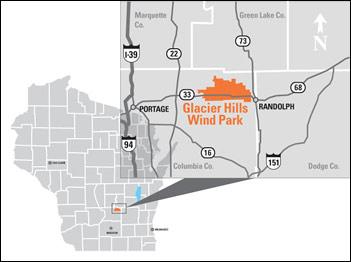
Illinios based Broadwind Energy recently revealed that its Wisconsin-based subsidiary, Tower Tech Systems will supply the Glacier Hills Wind Park project located in Central Wisconsin.

The wind farm is being developed by WE Energies with the design and construction services being provided by a partnership between the Boldt Company and Michels Corportaion.

Construction of the project began in May of this year with expectations of the turbines being installed "in the very near future."

Vestas will be manufacturing the turbines for the Glacier Hills Wind Park project and believes the turbines are capabile of generating enough power to supply up to 45,000 homes with electricity.


Saturday, November 27, 2010

Wisconsin Wind Energy Facts

Wind Projects and Potential


  • Wisconsin currently ranks 18th for total installed wind capacity


  • Percentage of Wisconsin power provided by wind in 2009: .66%


  • Wisconsin wind farms now online could power the equivalent of more than 110,000 homes


  • Wisconsin's wind resource is ranked 16th in the United States


  • Wisconsin's wind resources could provide over four times the states current electricity needs


Economic & Environmental Benefits

Investment in wind power is an investment in both long-term jobs in manufacturing and operations as well as temporary jobs during the construction of the wind project. In addition, wind power projects produce lease payments for farmers and increase the tax base of rural communities. Generating wind power creates no emissions and uses no water. The wind power installed in Wisconsin will avoid over 760,000 metric tons of carbon dioxide emissions annually.


  • Total direct and indirect jobs supported in 2009: 2,000-3,000


  • Annual property tax payments by wind project owners: $870,000


  • Annual land lease payments: $1.35 million

The wind industry creates opportunities for suppliers throughout the supply chain. At least 21 facilities in Wisconsin manufacture components for the wind energy industry and two more are announced.


Events

  • Wisconsin exhibitors at WINDPOWER 2010: 48

Friday, November 19, 2010

Wisconsin Wind Works Sees Success

The Wisconsin Wind Works has seen significant growth over the past year in growing the wind energy industry in the State. The Wisconsin Wind Works is a consortium of wind energy suppliers and manufacturers established by the New North, Inc.

This year the Wisconsin Wind Works Supply Chain Directory, a listing of companies involved in producing components and providing services to the industry added 40 companies. This has brought the statewide total to 279. Of the companies 68 percent reported they are currently supplying the wind energy market. This is a 24 percent increase from 2009.

Jerry Murphy, Executive Director of the New North, Inc. is pleased with the statistics and results of the New North and Wisconsin Wind Works to promote the assets of Wisconsin and capabilities of the companies within it. “With our state’s excellent advanced manufacturers and the success of our technical colleges in training workers for this industry, people across the country are recognizing that Wisconsin is the ideal place for component production and other wind energy services.”

On October 13th, the Wisconsin Wind Works hosted a wind energy symposium in Milwaukee which drew over 300 attendees. Attendees traveled from far and wide to attend the symposium form states as far away as California, Vermont, Florida and Texas. Ninety-five of the attendees were new contacts and business leads for Wisconsin Wind Works. As a result of the symposium three new companies joined the Wisconsin Wind Works Alliance as a result of the conference.

Wisconsin Wind Works also launched its new website–www.wiwindworks.com– in October and has received hundreds of visitors from 11 countries on four different continents. The Supply Chain Directory was redesigned to be more user friendly and offer enhanced search options and include the new category of business.

“We’re excited about the potential of this industry for the New North and the state as a whole, and we look forward to continued growth and success in the coming year,” Murphy said. “We’re also excited to report further on the efforts of Wisconsin Wind Works at the upcoming New North Summit on December 3.”

The 7th annual New North Summit will be held at the Kolf Sports Center at UW-Oshkosh. The efforts of Wisconsin Wind Works will be highlighted during the event, which will also feature Oshkosh-based Renewegy, LLC demonstrating their model wind turbine.

For more information on the Summit, please visit http://www.newnorthsummit.com.

Tuesday, November 16, 2010

State Support Sealed the Deal for Shirley Wind

Earlier this week, I had the privilege of attending a celebration of Shirley Wind, Wisconsin’s newest commercial wind installation. Located in the Brown County township of Glenmore, a mere 15 miles southeast of Lambeau Field, the project consists of eight Nordex N100 turbines rated at 2.5 megawatts (MW) apiece. All eight turbines are fully erected and will be turned on individually as part of the commissioning process. Commercial operation should begin in a few weeks.

There are many features of this project that stand out. The most obvious one is the turbines themselves, which are the tallest in Wisconsin and are among the tallest in North America. The nacelle is perched on a 100-meter tower (330 feet). Attached to the rotor are three blades extending 50 meters (165 feet). For comparison purposes, the tower is more than 60 feet taller than the next largest turbine in Wisconsin, the Vestas V82, and the blades are about 30 feet longer. According to Michels Wind, the general contractor for Shirley Wind, the spread foundations supporting these turbines are the largest in North America.

Between their height and blade length, Shirley Wind’s eight turbines will be the most productive wind generators in the state. The power conversion zone of a Nordex N100 is one-third larger than those of the Vestas and GE turbines located in Fond du Lac and Dodge counties. The turbine’s productivity is enhanced by the favorable wind resource that flows over the relatively flat terrain in southeast Brown County. All told, Shirley Wind’s turbines should produce about 64 million kilowatt-hours of electricity each year, which will exceed the annual output from the 20 turbines at the 30 MW Montfort installation in Iowa County, now in its 10th year of operation.

Another praiseworthy feature of Shirley Wind is the degree of local participation in the manufacturing and construction of the project. The towers were fabricated in Manitowoc by Tower Tech Systems. Manitowoc Crane supplied the giant crane that assembled the turbines. Brownsville-based Michels Wind Energy, which was also the general contractor for the 86-turbine Forward Energy Center surrounding its headquarters, organized and oversaw all facets of project construction. Numerous Wisconsin-based subcontractors, consulting engineers and natural resource professionals also made significant contributions to Shirley Wind. And Emerging Energies, the enterprising developer that started prospecting in this area in 2004 and drove the project forward across the finish line six years, is a Wisconsin corporation whose principals have deep roots in the Badger State.

It is no accident that the Shirley Wind project sets a new standard for Wisconsin content and participation. From its inception, Emerging Energies sought to maximize the benefits of windpower development to two important constituencies: Wisconsin businesses and the local community. As it turned out, its decision to partner with Tower Tech was a money-saving proposition, due to the very short distances needed to haul 80-ton tower sections from Manitowoc to the project site 25 miles away.

To build support among local officials, Emerging Energies agreed to set aside a portion of their receipts for compensating local governments and project neighbors, even though such payments are not required on power plants under 50 MW. The developer devised an innovative arrangement that allocates one-third of this revenue pool to the Town of Glenmore, one-third to Brown County, and one-third to project neighbors living within a certain distance of a wind turbine. This commitment to equitable distribution of revenues was no doubt instrumental in helping Emerging Energies secure a conditional use permit from the township in March 2007. This would have been no mean feat for a seasoned wind developer, let alone a relative newcomer to the industry.

With permit in hand, Emerging Energies set out to find an entity with an appetite for renewable energy. Initially, the developer approached Wisconsin utilities, which are required under 2005 Act 141 to increase the renewable energy content of the electricity they sell. However, by the time Emerging Energies started knocking on their doors, the utilities were already moving forward with their own acquisition plans, which emphasized owning and operating renewable generation sources over purchasing renewable electricity from third parties.

However, the same state law created another entity that needed to acquire renewable energy, namely, the State of Wisconsin. Under Act 141, which was signed into law in March of 2006, the State is obligated to source, by 2011, 20% of the electricity it consumes, or 184 million kilowatt-hours per year, from renewable resources. For state government officials, the purchasing requirement presented an opportunity to back an in-state wind project that could showcase Wisconsin’s prowess in manufacturing and construction as well as bolster the local economy. As a modest-sized project that had assembled a highly capable project development team, Shirley Wind shaped up to be an ideal fit for the State’s aspirations.

Because only utilities can legally sell electricity at retail, the State of Wisconsin and Emerging Energies needed to engage Wisconsin Public Service Corporation (WPS), the local utility, in a purchasing agreement that could allow the project to move forward. This was accomplished under a novel arrangement that allows WPS to purchase both electricity and renewable energy credits from Shirley Wind under a 20-year contract and resell the credits to the State of Wisconsin. The project is interconnected to a nearby WPS distribution-level substation, which enables Shirley Wind’s output to be directed into the host community and environs.

With this three-way arrangement in place, Emerging Energies then sold a 90% stake in Shirley Wind in late 2009 to an outside investor, Central Hudson Enterprise Corporation, a Poughkeepsie, N.Y.-based company. The other 10% of the project remains with Emerging Energies. Having consummated that investment, Shirley Wind cleared the last remaining preconstruction hurdle. Project construction commenced in April.

When fully operational, Shirley Wind will produce enough electricity to equal the annual consumption of approximately 8,000 households without discharging so much as an ounce of carbon dioxide into the atmosphere. At the same time, the project as well as generate thousands of dollars each year in supplemental income to host landowners and their neighbors. At every step of this six-year endeavor, Emerging Energies pursued its vision of locally beneficial renewable energy development in a patient and transparent manner, which eventually bore fruit when the State of Wisconsin decided to apply the power of the public purse to seal the deal for Shirley Wind. Shirley Wind represents an auspicious debut for Emerging Energies. Hopefully, there will be more projects coming through that particular pipeline.

WIRTTEN BY: Michael Vickerman, Executive Director of RENEW Wisconsin